

Obedience for Field Dogs ~ with Adele Yunk
 Recently, I was at a field training day for retrieving breeds where one of the group leaders said, “Now you see why it’s so important to do field work with your young dog, and save the obedience until later, because they can do that when they’re older.” I just bit my tongue, because in my mind, the two things go hand in glove. If you’re going to train field, you’d better be doing obedience at the same time.
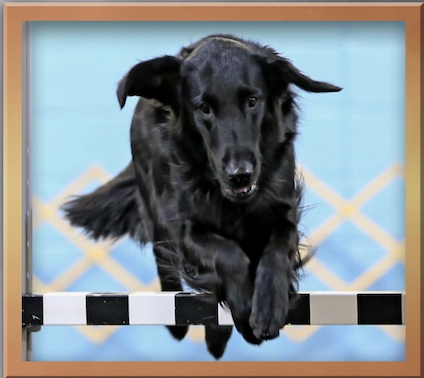
Adele Yunck, owner of Northfield Dog Training in Ann Arbor, Michigan, trains her flat-coated retrievers in both obedience and field. She says that obedience is the foundation for whatever we want to do with our dogs, including field work, and is the basis for developing a working relationship with a dog. Adele has been training dogs since 1985 and started Northfield Dog Training in 1990. She has earned numerous titles on her dogs, including multiple field titles and OTCHs.
“Doing obedience, creating that basic work that you do together, is really valuable,” she said. “Teaching a young dog how to learn is the important thing. You can teach a puppy obedience in your kitchen. You don’t have to travel to do it, and that teaches them how to learn.”
When you start talking about obedience and field, Adele said, you have to define what you mean by obedience.
“Field is essentially a lot of obedience skills,” she said, “and there’s a lot of obedience training that goes into the field.” Those obedience skills help shape the instinct of retrieving dogs to do what we expect of them in the field.
In fact, if you look at some of the drills we do with retrievers, you can see the relationship to Open and Utility exercises. Take, for instance, the “W” drill when the dog must go pick up a bumper from the pile that the handler designates; that’s gloves. Or watch a handler working a dog to a blind; it looks very much like a go out.
“The go out is based on a short blind retrieve,” Adele said. “That’s how a lot of people taught it initially. You put out a pile of dowels under a mat and if the dog failed to do the go out correctly it got ear pinched to a dowel. I’ve never used that technique, but I know people who have.”
For a field dog, one of the most important obedience skills is going to a target.
“You put a piece of food on a target and get the puppy staring at it,” Adele said. “Then you can begin to teach a double retrieve.” Well-known trainer Pat Nolan has a video, she said, where he has two targets out at 180 degrees. He puts a cookie on one and then turns and walk 20 feet away and puts a cookie on the other one.
“Then he backs up to the center between the two targets, and puts the puppy down facing the second cookie he put down, which is then the go bird,” Adele said. “The puppy goes out and gets it, and he calls the puppy back to him. Then he turns around, and the puppy is already facing the first target. He gets the puppy looking at the target and then he releases it to go get that cookie.” Adele tried this technique with Sonic, one of her flatcoats, and Jag, her current border terrier, and found it very successful in helping to teach go outs.
Another bit of obedience that helps for field work is learning to come to heel from in front of the handler. For this, Adele often uses a flat Costco produce box that has a “dip” in one end.
 “I start out having them get in from the short side and sit straight at heel,” she said. “Then I move to having them come from in front of me into it, and then sit while holding the bumper.” She also has used “get on a platform” for the same exercise.
Another field exercise that mirrors what we do in obedience is the “wagon wheel,” in which bumpers are laid out or thrown in a circle. The dog must retrieve the bumper that the handler indicates; this is very like gloves.
“I did this with Sonic, because she learned targets very young,” Adele said. “I would put out four targets in an arc and then work on wagon wheel.” She also taught Sonic casting by sending her to a platform or to a cone to get a treat.
The obedience skills for field, however, can be much more basic than casting or taking the bumper indicated by the handler. Sometimes they’re about the simple stuff: walking calmly on a leash amid the chaos that is a hunt test, a solid sit stay at heel in that same chaos, call to heel and call to front.
“You want a different type of attention in the field that what you want in obedience,” Adele said. “You don’t want them looking up at you, because you may be doing a walkup where they need to be looking out. But teaching them the basics of front and finish, and heel maneuvers, is very important. The heeling a dog does for field can be looser than for obedience, but you still want them to stay close to your side. Heeling in the field is controlled walking, and I differentiate between the two types of heeling.” And then there’s the retrieve on the flat and over the high jump and holding what the dog has retrieved until ordered to release it.
One of the drills that field trainers do with retrievers is a walking fetch, where the handler has placed a series of bumpers about 10 feet apart. As you approach each bumper, you tell the dog to “fetch.” The dog brings each bumper to heel, you take it and drop it behind you, and then move on to the next one.
“There’s a drill I do in obedience that’s very much like a walking fetch,” Adele said. “It’s a pickup drill, where you drop the dumbbell, and then you turn around and go back and as you pass it, you tell the dog to fetch it and then you keep walking. If they don’t fetch it quickly enough, they’re going to miss it. You can do that drill with a single bumper and then add more, or you can use an article or a glove.”
Another basic obedience skill for the field is a good recall.
“The biggest problem people have if their dog has a desire to retrieve, is lack of recall outside,” Adele said. “A good recall in every situation is very important. That’s a really vital obedience skill.”
Doing a lot of obedience work before you take your dog into the field can pay off big dividends. Adele recalled a hunt test she attended years ago where she watched a black Lab bitch with beautiful field manners.
“This was in a senior test,” she said. “Her manners were just impeccable. She was in good control, and sat patiently in the blind waiting, and then she went out and just smacked the test. She was fabulous.”
Adele went to the club dinner that night, and the handler was there.
“I complimented him on her and told him that I was really impressed with both how she ran the test and the level of control he had,” she said. “He told me that for every day he did marks and blinds he did a day of obedience.”
That young man was a trainer with the right idea about a balance between field work and obedience. The two of them, trained in parallel, can enhance your team’s performance in both venues. Rather than thinking of them as two separate skill sets, think of them as the two sides of the same coin. Work on them at the same time, and you’ll improve your success in both.