
Book Review: Musings On A Balancing Act
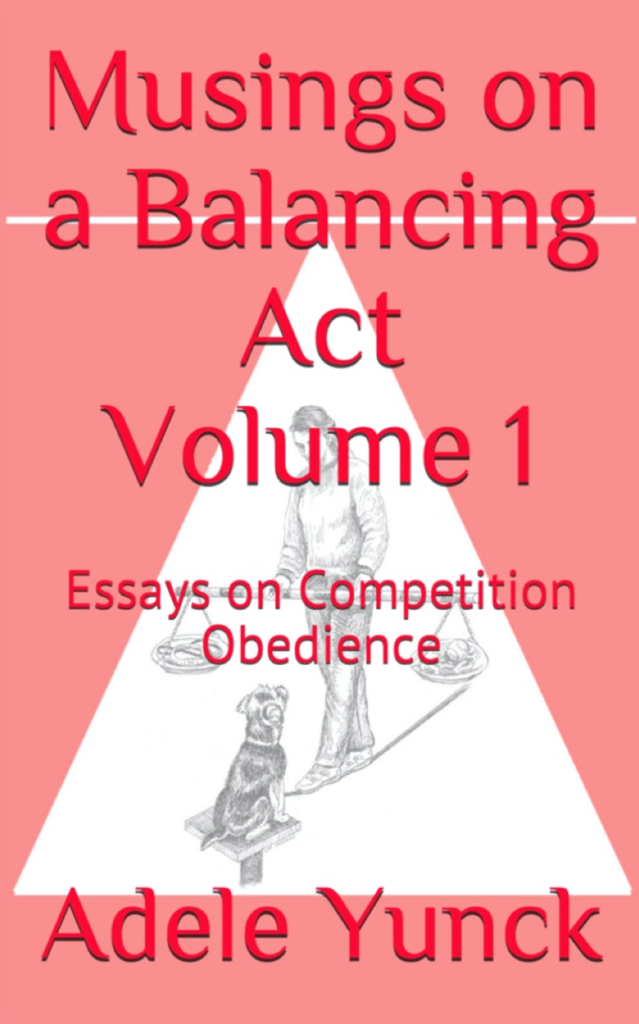 Adele Yunck has written two classic competitive obedience books: the first, Competition Obedience: A Balancing Act, co-authored with the late Judy Byron, is an almost 400 page tome known as the “Big Red Bible” of obedience training, and the second, The Art of Proofing: Preparing Your Dog for Obedience Trials, has provided countless trainers/instructors with creative and progressive proofs to solidify dogs’ understanding of obedience exercises. In her latest book, Musings on a Balancing Act, Yunck discusses her own habits and lessons learned from her decades of training, trialing, and teaching.
As a collection of essays, this slim volume has the feel of a series of casual conversations with an experienced obedience competitor and instructor. Instead of discussing how to train particular exercises, Yunck shares her approach to training and trialing in stand-alone essays that run the gamut from weaning off food to dumbbell fit. Look to Yunck’s prior books for details on training and proofing specific exercises; this book’s essays take a step back from those details to talk in more general terms about how one can improve training and trialing.
For example, in the essay “Training and Trial Logs” Yunck lets us peek at her prodigious record keeping. She documents training sessions, trial performance, and title progression for each of her dogs. Most valuable, she includes sample pages from her logs with explanations of what she was tracking and how she uses the data she collects, as well as how her logs have evolved with time and technology. You might not want to adopt Yunck’s record keeping practices wholesale, but I guarantee you’ll start thinking about what you would like to track and why. Similarly, in “The Care and Feeding of a Training Partner,” Yunck discusses the value of having a training partner and offers numerous suggestions for how to find a compatible one. If you already have a training partner, you’ll get ideas about additional ways you can support one another; if you don’t have one already, you’ll understand the value of seeking one out.
Yunck seems to have a unique ability to see and articulate fundamental principles that most of us must learn by (obedience) trial and error. She demystifies some of the characteristics of top competitors so that even novices can benefit. One essay, “Developing a Critical Eye,” discusses how to evaluate your own performance by learning to see what a judge sees. Yunck provides numerous specific, actionable ways you can develop that critical eye, from videoing your training session to sitting ringside with a more seasoned competitor. In “Setting Training Goals,” she dissects how to move from an ambitious end goal to what you will train today.
Not all essays will speak to all readers, and some of the essays presume familiarity with Yunck’s training methods and vocabulary, but every reader is likely to find valuable nuggets in this collection. Fundamentally, this book will get you thinking, make you curious about how you can improve your training and trial performance, and encourage you to experiment with some of Yunck’s practices and suggestions. It is a fitting companion to Yunck’s previous contributions to the sport, and we can only hope its designation as Volume One means that a second volume is in the works. Do note that these essays were originally published on Yunck’s blog, so regular readers of her blog have likely seen them before.
Adele Yunck has written two classic competitive obedience books: the first, Competition Obedience: A Balancing Act, co-authored with the late Judy Byron, is an almost 400 page tome known as the “Big Red Bible” of obedience training, and the second, The Art of Proofing: Preparing Your Dog for Obedience Trials, has provided countless trainers/instructors with creative and progressive proofs to solidify dogs’ understanding of obedience exercises. In her latest book, Musings on a Balancing Act, Yunck discusses her own habits and lessons learned from her decades of training, trialing, and teaching.
As a collection of essays, this slim volume has the feel of a series of casual conversations with an experienced obedience competitor and instructor. Instead of discussing how to train particular exercises, Yunck shares her approach to training and trialing in stand-alone essays that run the gamut from weaning off food to dumbbell fit. Look to Yunck’s prior books for details on training and proofing specific exercises; this book’s essays take a step back from those details to talk in more general terms about how one can improve training and trialing.
For example, in the essay “Training and Trial Logs” Yunck lets us peek at her prodigious record keeping. She documents training sessions, trial performance, and title progression for each of her dogs. Most valuable, she includes sample pages from her logs with explanations of what she was tracking and how she uses the data she collects, as well as how her logs have evolved with time and technology. You might not want to adopt Yunck’s record keeping practices wholesale, but I guarantee you’ll start thinking about what you would like to track and why. Similarly, in “The Care and Feeding of a Training Partner,” Yunck discusses the value of having a training partner and offers numerous suggestions for how to find a compatible one. If you already have a training partner, you’ll get ideas about additional ways you can support one another; if you don’t have one already, you’ll understand the value of seeking one out.
Yunck seems to have a unique ability to see and articulate fundamental principles that most of us must learn by (obedience) trial and error. She demystifies some of the characteristics of top competitors so that even novices can benefit. One essay, “Developing a Critical Eye,” discusses how to evaluate your own performance by learning to see what a judge sees. Yunck provides numerous specific, actionable ways you can develop that critical eye, from videoing your training session to sitting ringside with a more seasoned competitor. In “Setting Training Goals,” she dissects how to move from an ambitious end goal to what you will train today.
Not all essays will speak to all readers, and some of the essays presume familiarity with Yunck’s training methods and vocabulary, but every reader is likely to find valuable nuggets in this collection. Fundamentally, this book will get you thinking, make you curious about how you can improve your training and trial performance, and encourage you to experiment with some of Yunck’s practices and suggestions. It is a fitting companion to Yunck’s previous contributions to the sport, and we can only hope its designation as Volume One means that a second volume is in the works. Do note that these essays were originally published on Yunck’s blog, so regular readers of her blog have likely seen them before.